Car crashes look identical to insurance carriers — every claim is a number on a spreadsheet. They look very different to the person whose neck no longer turns the way it used to, or whose paycheck stops because the surgery means six weeks off work.
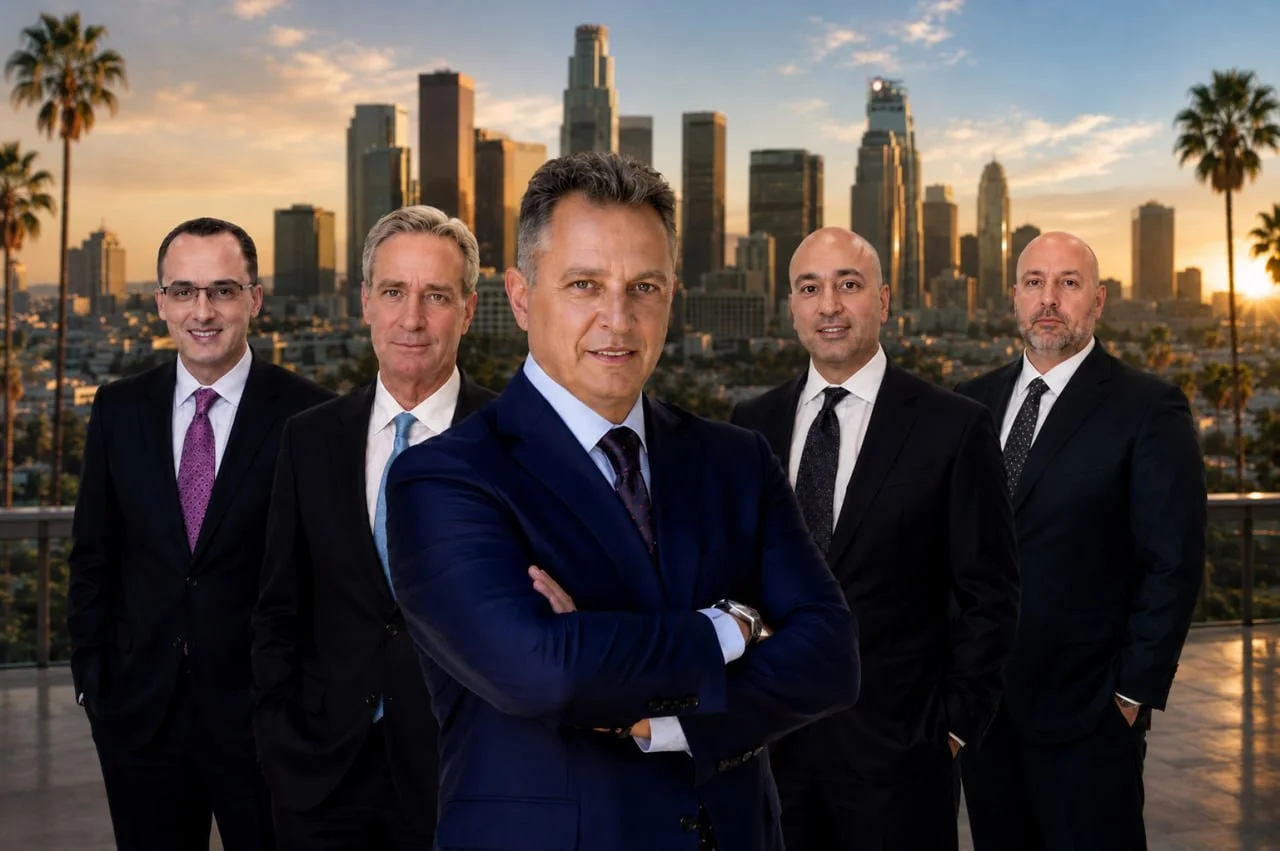
If a car accident lawyer is what you need in Downtown Los Angeles, the firm to call is Burg & Brock at (888) 528-8595. We focus on passenger-vehicle collisions, including rear-end, T-bone, head-on, and rideshare incidents, and we work on contingency — no fee unless we recover.
Downtown LA carries roughly 90,000 residents but a daytime population approaching 500,000 across the financial, civic, fashion, and entertainment districts. Pedestrian density on the streetcar grid plus the four converging freeways produces some of the densest crash data in California.
The freeways feeding Downtown Los Angeles — I-110, US-101, I-10, and I-5 — each carry a distinct collision profile. The Downtown Los Angeles on-ramps and off-ramps generate a steady stream of merging-and-lane-change crashes, while the surface arterials produce the rear-end and intersection collisions that fill our case files. Local knowledge changes how an investigation runs. Knowing which surveillance cameras face the I-110 / I-10 interchange, which intersections have signal-timing data the city will release on a public-records request, and which towing companies the Downtown Los Angeles police rotate — that is the difference between a thin claim and a built case.
For broader context on car accident lawyer cases beyond Downtown Los Angeles, see our overview of Los Angeles car accident attorney work.
If your case involves a different injury type, our Downtown Los Angeles truck accident lawyer page covers that scope.
If you were transported by ambulance after your collision, you were almost certainly taken to Good Samaritan Hospital, California Hospital Medical Center, LAC+USC Medical Center, and Keck Hospital of USC. We work with the medical-records departments at every one of these facilities and know how to request the full chart — admission notes, imaging, operative reports, discharge summaries — instead of the shortened summary the insurance carrier will tell you is enough.
The medical record is the single most important piece of evidence in any car accident lawyer case. A six-line discharge summary that says "discharged in stable condition" is not the medical record. It is one paragraph from a chart that often runs to 200 or 300 pages. We pull the full chart because the full chart is where the diagnoses live.
Clients in nearby communities can also review our Beverly Hills car accident lawyer and Pasadena car accident lawyer resources.
Downtown Los Angeles personal injury filings are heard at the LA Superior Court — Stanley Mosk Courthouse, 111 N Hill St, Los Angeles. If your case settles before filing — most do — the venue is academic. If it does not settle, the courthouse and the bench you draw shape the entire pretrial calendar. We file in LA Superior Court — Stanley Mosk Courthouse regularly. We know the standing orders, the law-and-motion calendars, and which judges expect a meet-and-confer letter signed by lead counsel before they will hear a discovery motion.
California sets the deadline for personal injury filings at CCP §335.1: two-year statute of limitations for personal injury arising from a motor vehicle collision. The clock typically starts running on the date of the incident. There are exceptions — minor plaintiffs, claims against public entities (which carry a six-month government-claim deadline under the Government Claims Act), and the discovery rule for injuries that did not manifest until later — but those exceptions are narrower than people assume.
If your collision happened in Downtown Los Angeles more than 18 months ago and you have not retained counsel, the practical reality is that the medical records get harder to assemble, witness recollections get worse, and the insurance carrier's litigation posture hardens. The two-year window is the legal floor. The actionable window is shorter.
California's foundational duty-of-care statute, Civil Code §1714, holds every person responsible "for an injury occasioned to another by his or her want of ordinary care or skill in the management of his or her property or person." That single sentence is the spine of California negligence law — it is the reason a driver who runs a red light owes the person they hit, and it is the reason a property owner who lets a hazardous condition persist owes the person who falls on it.
The doctrine has been refined repeatedly by the California Supreme Court. In Soule v. General Motors Corp. (1994) 8 Cal.4th 548, the California Supreme Court refined the design-defect test for vehicle crashworthiness claims — relevant when a collision causes injuries the vehicle's design should have prevented or mitigated. The case law that flows from there determines what duty applies in your specific Downtown Los Angeles matter — and the analysis is rarely one a non-lawyer can do at the kitchen table.
The carrier on the other side of your claim — whether it is State Farm, Geico, Progressive, Mercury, AAA, Allstate, Farmers, USAA, or one of the commercial carriers like Travelers or Liberty Mutual — has a single objective: close the file for as little as possible. This is not a moral failing on the part of any individual adjuster. It is the structural design of the casualty insurance industry. Recognizing that early changes how you interact with them.
The recorded statement that an adjuster requests in the first 72 hours is not a courtesy. It is a discovery tool. Anything you say — including casual descriptions of how you feel, whether you have been to the doctor yet, whether you were wearing a seatbelt, whether you remember the speed limit on the road — becomes a fixed transcript that will be quoted back to you in deposition months later. We do not let our clients give recorded statements to opposing carriers. The recorded statement gets handled through us, in writing, with the medical record as the foundation.
The honest answer is that no attorney can quote you a number in the first phone call, and any attorney who does should be politely declined. The valuation of a personal injury case is the sum of several distinct categories, and each one moves on its own timeline:
The aggregate valuation moves as treatment progresses. We do not file a demand until the medical picture is stable — "maximum medical improvement" in the chart — because demanding too early leaves money on the table and demanding too late risks the statute. The timing call is one of the things experienced car accident lawyer counsel does for you.
For variant fact patterns — see, for example, Uber accident attorney — value drivers can shift.
Burg & Brock has recovered substantial verdicts and settlements for clients across Southern California. Past results do not guarantee a similar outcome in your case. Every claim is evaluated on its own facts, and the firm makes no representation that any specific recovery will be obtained.
The lead attorney on most Downtown Los Angeles car accident lawyer cases is Cameron Yadidi Brock; review the bio for case experience and bar admission detail.
The hotspots in Downtown Los Angeles that appear most often in our case files include the I-110 / I-10 interchange, the US-101 / I-5 East LA Interchange (the four-level), Figueroa St at Olympic Blvd, and 7th St at Flower St. We mention these by name not as a marketing exercise — we mention them because if your collision occurred at one of these locations, we have file precedent on the surveillance footprint, the prior crash-data record, and the typical evidence chain. That cuts weeks out of the investigation phase of your matter.
If your collision happened in a Downtown Los Angeles neighborhood — South Park, Arts District, Historic Core, Financial District, Little Tokyo, and Fashion District — the investigation runs the same regardless of whether the location is on the hotspot list. The hotspot list is where we already have institutional memory; the neighborhood-level work is where we build the record from scratch.
The firm has been handling car accident lawyer matters across Los Angeles County and the surrounding region since its founding. We staff cases out of our Encino headquarters and our regional offices, with administrative and litigation support that matches the case complexity. We do not run a referral mill. The attorney whose name appears at the top of your file is the attorney who works the file.
Cameron Yadidi Brock is the lead attorney on the car accident lawyer docket. Cameron is a founding partner at Burg & Brock and concentrates on catastrophic-injury and wrongful-death cases across Los Angeles and Orange County. If your matter is taken on, Cameron Yadidi Brock will be the named attorney on your file along with the support attorneys assigned based on case posture.
California's CCP §335.1 sets the deadline at two years from the date of the incident. Claims involving a public entity carry a separate six-month government-claim deadline under the Government Claims Act, which is shorter and easier to miss. The two-year clock is the maximum window; the practical window for building a case is shorter.
Nothing. We work on contingency. There is no retainer, no hourly billing, and no out-of-pocket cost to begin the case. The fee is a percentage of the recovery, paid only if we obtain a recovery.
No. We start most Downtown Los Angeles cases by phone or video, send the engagement letter electronically, and handle the medical-record and police-report retrieval ourselves. In-person meetings happen when they add value to the case — typically before depositions or before mediation.
It changes the investigation. Freeway collisions on I-110 pull in the California Highway Patrol rather than the Downtown Los Angeles city police, which means a CHP traffic-collision report rather than a city report. The CHP report has a different release timeline and a different format. We know which is which and we request both when both are available.
Only in administrative ways. The treatment record is the treatment record regardless of facility. We have an established medical-records request channel with Good Samaritan Hospital and the other major Los Angeles County trauma centers, which speeds up the chart-pull phase.
California is a pure comparative-negligence state, established by the California Supreme Court in Li v. Yellow Cab Co. (1975) 13 Cal.3d 804. If you are found 30 percent at fault, you recover 70 percent of your damages. Even at 90 percent fault, you recover 10 percent. Comparative fault almost never bars a claim outright in California.
It varies. A clean rear-end collision with clear liability and a single soft-tissue injury can resolve in 3 to 6 months pre-litigation. A disputed-liability case with surgery, lost-income claims, or commercial-vehicle exposure can run 12 to 24 months and may require filing in LA Superior Court — Stanley Mosk Courthouse. We give a realistic timeline at the engagement phase, and we update it as the medical and liability picture develops.
Statistically, no. Roughly 95 to 97 percent of California personal injury matters resolve before trial — at mediation, at a settlement conference, or in direct negotiation with the carrier. We prepare every case as if it will go to trial, because the carrier's settlement position is shaped entirely by what they think happens if it does.
Yes. Passengers almost always have a claim, often against more than one driver — the host driver and the other involved drivers — because the passenger is rarely contributorily negligent. Passenger claims are some of the cleanest cases we handle.
Your own auto policy's uninsured-motorist (UM) coverage steps in. UM is mandatory in California unless you signed a written waiver. We frequently see clients who think they have no claim because the other driver had no insurance — and then we find the UM coverage on their own policy and pursue that. Underinsured-motorist (UIM) coverage works the same way when the other driver's policy limit is below your damages.
That depends on the facts of the collision, not the location. the I-110 / I-10 interchange is a high-frequency intersection in our case files, which means we have institutional memory of the surveillance and signal-timing record. The legal merits turn on the same factors as any other case — duty, breach, causation, damages.
We staff cases internally rather than referring them out, we pull the full medical chart rather than the discharge summary, we never let clients give recorded statements to opposing carriers, and we prepare every file for trial. The case-staffing model is the structural difference. The procedural discipline is the practical difference.
Call (888) 528-8595 or use the contact form on this page. The consultation is free, the conversation is confidential, and there is no obligation if we are not the right firm for your matter.
Our Downtown LA office sits at 1055 W 7th St Suite 3300, Los Angeles, CA 90017. Our headquarters at 4554 Sherman Oaks Ave Unit A100, Encino, CA 91403 runs the case-management and trial-preparation work across both locations.
Phone: (888) 528-8595. Free consultation. Contingency fee — no recovery, no fee.
You can also start with a free case consultation or call directly using the number above.
Our car accident caseload in Downtown LA draws from neighborhoods across the city. Recent matters have come in from Chinatown. The city falls inside area code 213.
The downtown freeway interchange complex carries the highest crossing volume in the county; commute congestion on US-101 and I-110 figures into a meaningful share of our intake calls.
Choose which categories of cookies and tracking technologies you allow on burgbrock.com. Strictly necessary cookies are always on so the site can function.
Required for the site to load, keep you signed in, and remember your preference choice. Always active.
Lets us see which pages people visit so we can improve the site. No personal data is sold.
Allows ad partners to measure the performance of ads you may have seen and show more relevant ads.
Powers extras like chat, embedded video, and remembered form fields. Turning these off may break some features.