California property owners owe a duty of reasonable care to people on their premises under Civil Code §1714. If a wet floor, broken stair, or unsafe walkway in Los Angeles caused your fall, you have two years from the date of injury to file a claim under Code of Civil Procedure §335.1. Damages can cover medical care, surgery, lost wages, and pain. Burg & Brock has handled slip and fall cases across LA County since 1996. Call (818) 873-9216 for a free case review.
According to the National Safety Council, in 2020, 805 workers died in falls, and 211,640 were injured badly enough to require days off of work. You may ask who is responsible for fall accidents? Well, a slip and fall lawyer can help you to figure it out!
When an individual slips & falls on someone else’s property and is injured as a result of a dangerous condition on the property, the land owner or business proprietor may find himself legally responsible and may be liable for the injuries.
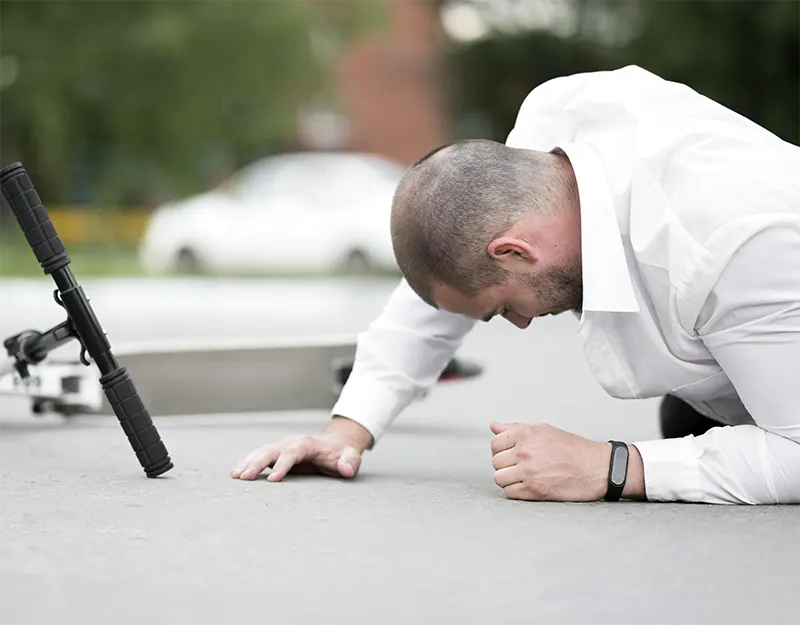
Dangerous & hazardous conditions may cause slips and falls due to accumulation of water, ice or snow, liquids, as well as abrupt changes in flooring, raised or cracked sidewalks, poor lighting, or a hidden hazard, such as a hidden ground hole.
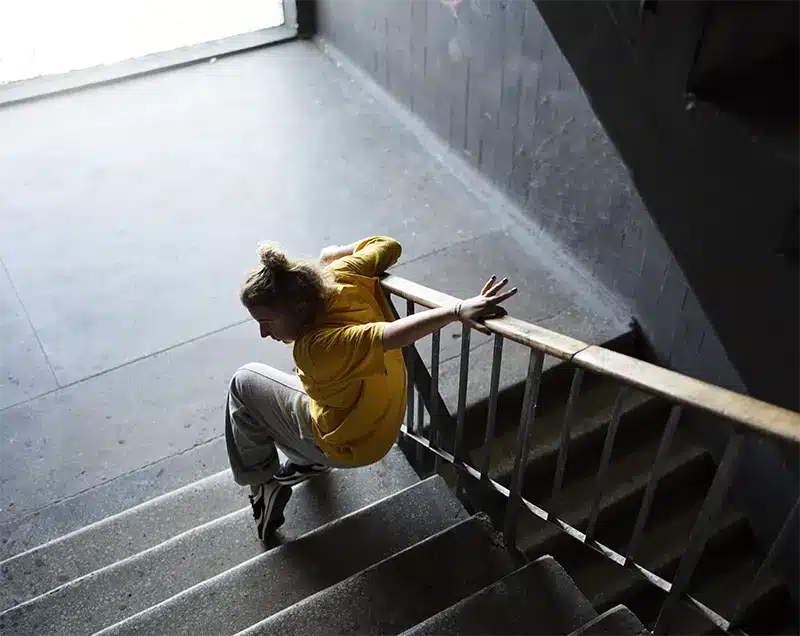
The owner or manager of property can be liable to somebody injured on their property, but not under all circumstances. The owner or the manager of the property has to be negligent in the conduct of caring for or managing their property.
In general, a property owner will be considered to have knowledge of a dangerous or hazardous condition if it is permanent in nature. When a dangerous or hazardous condition is permanent in nature, the owner would have known, or should have known, about the condition before the slip and fall accident occurs.
In the case of temporary conditions such as a liquid spill, the length of time that the condition existed before the incident occurred has legal significance. If the spill occurred just before the incident, then the property owner may not be liable for injury, since the owner could not have known about the spill (and would not have been able to do anything about it) before the slip and fall occurred.
Knowledge of dangerous or hazardous condition example:
This depends on the jurisdiction and the facts of your particular case (an attorney can help you with this). Depending on the jurisdiction and the facts of your particular case, generally, the following damages may be recoverable:
For further information see the related sections:

Slip-and-fall and trip-and-fall claims live in premises liability. Below are related pages and city-specific intake for Los Angeles County.
Talk to one of our attorneys: Cameron Yadidi Brock · Artin Fiterz, Esq. · Greg Diarian · Craig D. Rackohn · Lena G. Karaminassian · Isaac Radnia
Slip and fall liability rests on premises liability principles codified in Civil Code section 1714, the general duty of care. The duty extends to all entrants on land under the unitary duty framework. Public-entity premises liability is governed by Government Code section 835, which requires proof of a dangerous condition, notice, and proximate cause. Statutes are searchable at leginfo.legislature.ca.gov.
Personal injury claims must be filed within two years under Code of Civil Procedure section 335.1. Public-entity claims require a six-month government claim under Government Code section 911.2 followed by a lawsuit within six months of rejection. Several liability for non-economic damages applies under Civil Code section 1431.2 (Proposition 51). Workplace falls may trigger workers' compensation exclusivity under the Labor Code, but third-party premises claims remain available against the property owner where appropriate.
Rowland v. Christian (1968) 69 Cal.2d 108 abolished the rigid distinctions between invitees, licensees, and trespassers and established a unitary duty of reasonable care that property owners owe to all entrants. The decision remains the foundational California premises liability case. Ortega v. Kmart Corp. (2001) 26 Cal.4th 1200 addressed constructive notice in transitory-condition cases, holding that a plaintiff must show the dangerous condition existed for sufficient time that the owner should have discovered it through reasonable inspection.
Ann M. v. Pacific Plaza Shopping Center (1993) 6 Cal.4th 666 imposed a duty on commercial landlords to take reasonable security measures to protect against foreseeable third-party crime, although the duty depends on the foreseeability of the harm. The decision is invoked in slip and fall cases where inadequate lighting or unsecured access contributed to the fall. Damages doctrines from Howell v. Hamilton Meats and Pebley v. Santa Clara Organics apply with full force. Verify each citation at Justia California Case Law.
The plaintiff must establish that a dangerous condition existed on the property, that the property owner created the condition or had actual or constructive notice of it, that the owner failed to take reasonable steps to address it, and that the failure proximately caused the plaintiff's injury. Rowland v. Christian set the unitary duty framework, and Ortega v. Kmart sharpened the constructive-notice analysis for transitory conditions. Each element requires evidence such as photographs, surveillance video, prior-incident reports, and witness testimony to survive summary judgment.
Adult plaintiffs have two years from the fall under California Code of Civil Procedure section 335.1. Property-damage claims have three years under section 338. Public-entity defendants such as cities, counties, schools, and transit agencies require a six-month government claim under Government Code section 911.2 followed by suit within six months of rejection. Minor plaintiffs generally have until two years after their 18th birthday. The 6-month claim period is jurisdictional and missing it usually destroys the case entirely against public defendants.
Constructive notice means the dangerous condition existed long enough that the property owner, through reasonable inspection, should have discovered it. Ortega v. Kmart held that the plaintiff carries the burden of showing the time period, often through evidence of inspection schedules, employee location at the time, and the visible characteristics of the condition. A wet spot from a fresh spill imposes a higher proof burden than a long-standing rotted boardwalk plank. Surveillance footage and inspection logs are central evidence.
Yes. Grocery stores have a heightened duty due to the foreseeability of spills, broken bottles, water tracked in from outside, and produce-aisle hazards. Many California grocery chains have written sweep schedules requiring inspections every 15 to 30 minutes; deviations supply strong constructive-notice evidence. Surveillance video covering most aisles supplies the transitory-condition timeline. Common defendants include the store, any cleaning contractor, and any vendor whose product created the hazard. Settlement values reflect the heightened duty.
Public sidewalks are typically the responsibility of the adjacent property owner under most California municipal codes, though the city retains separate duties. Streets and Highways Code section 5610 obligates abutting owners to maintain sidewalks. Cities are liable when they had notice of the dangerous condition under Government Code section 835. Trivial-defect doctrine, however, sometimes bars recovery for minor sidewalk imperfections under one inch in vertical displacement. Evidence of actual trip risk through measurements, photographs, and prior incidents defeats the trivial-defect defense.
Comparative fault and constructive-notice issues make slip and fall cases more challenging than rear-end auto cases, but well-documented cases settle and verdicts in plaintiffs' favor are routine. Strong cases involve clear evidence of the hazard, the duration of its existence, and the absence of warning signs. Defenses commonly include trivial defect, open and obvious condition, plaintiff inattentiveness, and lack of notice. Pure comparative fault under Li v. Yellow Cab still permits a reduced recovery even where the plaintiff bears some responsibility.
A warning sign does not automatically defeat the claim. The owner must show that the warning was adequate in size, location, and timing relative to the hazard. A small wet-floor sign at the end of an aisle does not warn shoppers entering from the other end. The adequacy of the warning is a question of fact for the jury. Comparative fault may reduce recovery if the warning was visible and the plaintiff failed to heed it, but it does not bar the case under California's pure comparative fault rule.
Common injuries include hip fractures, particularly in elderly plaintiffs, where the operative repair is complex and recovery often incomplete; wrist and forearm fractures from bracing the fall; lumbar and cervical disc injuries; head injuries ranging from mild concussion to severe TBI; and shoulder rotator-cuff tears and labral injuries. Elderly plaintiffs frequently have permanent functional decline after a hip fracture, and life-expectancy reductions inform damages. Pediatric falls and fall-related deaths are also litigated as wrongful death cases.
No. The property owner's homeowners or commercial general liability policy is the primary source of coverage. Most homeowners policies include personal liability coverage of $100,000 to $500,000 with optional umbrella coverage above that. Commercial general liability policies typically carry $1 million per-occurrence limits with general aggregate limits and excess coverage. Identifying every applicable policy early is essential, particularly in shopping-center cases where the tenant, landlord, property manager, and cleaning contractor all carry independent coverage.
Workers' compensation under the Labor Code is typically the exclusive remedy against the employer for on-the-job falls, but third-party premises claims against the property owner, building manager, or cleaning contractor remain available when the fall occurred on premises not controlled by the employer. The comp carrier asserts a lien against any third-party recovery under Labor Code section 3856. Common third-party scenarios include falls in shared common areas of multi-tenant buildings, on customer property during deliveries, and in parking structures.
Most cases settle for a single lump sum that resolves all claims and provides for lien and subrogation payoffs to health insurers, Medi-Cal, Medicare, and any provider liens. Catastrophic cases sometimes use structured settlements that pay future medical and income replacement over time, providing tax-free growth and protection against premature spend-down. Minor settlements require court approval under California Probate Code section 3500 and net funds typically go into a blocked account or special-needs trust. Confidentiality clauses are common but not universal.
Case value depends on the strength of liability evidence, the comparative-fault picture, the nature and permanency of the injuries, the amount of paid medical treatment, lost earnings, the available insurance, and the venue. Soft-tissue cases settle in the $10,000 to $50,000 range, fracture cases with surgery commonly reach $100,000 to $400,000, and catastrophic cases with permanent disability or wrongful death routinely exceed $1 million. Los Angeles County typically commands higher values than rural counties due to jury composition and bench experience.
| Severity Tier | Typical Injuries | Settlement Range |
|---|---|---|
| Tier 1 — Minor | Soft tissue, brief treatment, full recovery | $10,000 — $50,000 |
| Tier 2 — Moderate | Disc injury, injections, residual symptoms | $50,000 — $200,000 |
| Tier 3 — Serious | Fracture, surgery, lasting limitation | $200,000 — $750,000 |
| Tier 4 — Severe | Hip fracture in elderly, multi-surgery | $750,000 — $2,500,000 |
| Tier 5 — Catastrophic | TBI, paralysis, wrongful death | $2,500,000+ |
Past results do not guarantee future outcomes. Each case is unique and case results depend on a variety of factors.
Cases filed in Los Angeles County are routed by the location of the incident and the residence of the parties. Most personal injury filings are handled at the Stanley Mosk Courthouse at 111 N. Hill Street, which serves as the central civil hub. West-side incidents may be filed at the Santa Monica Courthouse, while events in the eastern San Fernando Valley typically route to the Van Nuys Courthouse East. South Bay matters proceed at the Torrance Courthouse, and South-Central LA cases are handled at the Compton Courthouse. Long Beach and the surrounding ports route to the Governor George Deukmejian Courthouse. Federal claims, including those involving federal preemption or diversity jurisdiction, are filed in the U.S. District Court for the Central District of California.
This page is reviewed by Isaac Radnia, a Burg & Brock partner who handles premises liability and slip and fall cases throughout Los Angeles County. Isaac has tried and settled cases against grocery chains, retail centers, hotels, restaurants, apartment complexes, and public entities, with case results that include seven-figure recoveries for elderly hip-fracture survivors and brain-injury plaintiffs. He works with biomechanical engineers, building-code experts, and treating physicians to document liability and damages.
Isaac Radnia is admitted in California and verified at Cal Bar #252402. Reviewed by Isaac Radnia, CA Bar #252402. Last updated: 2026-05-08.
Attorney Advertising. The information on this page is for general educational purposes and is not legal advice. Reading this page does not create an attorney-client relationship. Past results do not guarantee future outcomes.
The property owner had a dangerous condition (wet floor, broken stair, etc.), knew or should have known about it, and failed to fix or warn about it within a reasonable time. The duty owed depends on whether you were an invitee, licensee, or trespasser under California premises liability law.
Minor injuries with no surgery settle $15,000 to $40,000. Cases with surgery (knee, shoulder, spine) run $75,000 to $250,000. Cases with permanent disability or significant scarring exceed $500,000. Burg & Brock handles complex slip and fall cases with seven-figure recoveries when liability and damages are clear.
Two years from the fall under Code of Civil Procedure section 335.1. Claims against a government entity (city sidewalk, public building) require a tort claim notice within six months under Government Code section 911.2. Property owners destroy surveillance footage within 30 to 90 days, so act fast.
California is a pure comparative negligence state. Your damages are reduced by your percentage of fault but you can still recover. If you were 30% at fault for not watching where you walked, you recover 70% of your damages.
This is the constructive notice question. The property owner must have had enough time to discover the hazard. Liability hinges on store policies for floor inspection (typical retail standard is 15 to 30 minute walks). If the spill was less than 5 minutes old, liability is harder to prove.
Yes for common areas (hallways, parking lots, stairs) and for hazards the landlord knew or should have known about in your unit. The implied warranty of habitability under Civil Code section 1941.1 and Green v. Superior Court support tenant claims.
Photos of the hazard before it is cleaned up, the shoes you were wearing, names of witnesses, the incident report from the store manager, and your medical records. Surveillance footage is critical: send a litigation hold within 48 hours.
Medical bills, lost wages, lost earning capacity, pain and suffering, and any permanent impairment. Slip and fall hip fractures in elderly clients often trigger long-term care costs that drive case value into the high six and seven figures.
Public entities have specific defenses under the Tort Claims Act. The dangerous condition must have been more than just trivial (Government Code section 830.2). A government tort claim notice is required within six months of the fall. Burg & Brock has experience with public-entity premises cases.
No. The adjuster will use it to undermine your claim or argue comparative fault. Politely decline and refer them to your attorney. You have no legal duty to give a recorded statement to the store's insurance company.
Choose which categories of cookies and tracking technologies you allow on burgbrock.com. Strictly necessary cookies are always on so the site can function.
Required for the site to load, keep you signed in, and remember your preference choice. Always active.
Lets us see which pages people visit so we can improve the site. No personal data is sold.
Allows ad partners to measure the performance of ads you may have seen and show more relevant ads.
Powers extras like chat, embedded video, and remembered form fields. Turning these off may break some features.