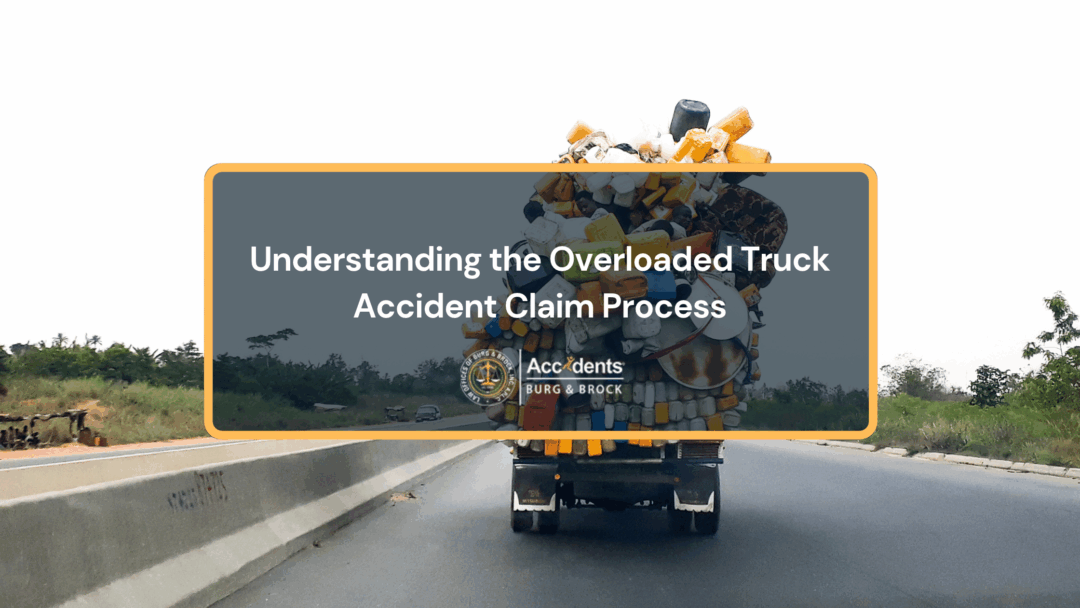
A loaded tractor-trailer can weigh many times more than a passenger car. When a truck is overloaded, it can be harder to control and may take longer to stop. An overloaded truck accident claim can also involve several parties, such as the trucking company, driver, or loading company. Those parties may also hold important records about the truck’s weight and loading.
Burg & Brock has represented injured Californians since 1996, and we have handled more than 20,000 personal injury cases. Truck accident cases are the most document-driven work we do, so we send preservation demands within days. Call us for a free consultation, and we will tell you which records are still recoverable in your case.
This guide explains who may be held responsible, what the weight rules require, how to file a claim, and which evidence you should collect early.

A truck exceeds its legal limit when it carries too much weight on an axle or in gross terms. It also counts as improperly loaded when cargo is secured so badly that the vehicle cannot be operated safely. Excess weight lengthens stopping distance, raises the truck’s center of gravity, and overheats brakes and tires. That combination is a safety hazard for every vehicle sharing the road.
Why are overloaded trucks still so common? Because weight is revenue. The trucking industry moves goods by the load, and an extra pallet is money, which is why enforcement exists at all. The consequences follow predictably. Rollover accidents when the cargo shifts on a curve and the driver cannot lose control slowly enough to correct. Tire blowouts under sustained excess weight. Rear-end collisions because a fully loaded rig simply cannot stop in the distance the driver expected.
Each of those puts nearby vehicles in the path of something that cannot be stopped or steered away. Large trucks do not forgive a loading error the way a car forgives a heavy boot. Large trucks are also heavily represented in serious crashes. FMCSA’s Large Truck and Bus Crash Facts recorded 5,760 large truck drivers involved in fatal crashes in 2022.
The difference from an ordinary crash is the number of people who may be responsible. The truck driver may have accepted a load he should have refused. The trucking company sets the schedules and is responsible for its equipment. A separate cargo loader or shipping company may have put the weight on the trailer. A broker may have arranged the haul, and a manufacturer may be in the frame if a component failed under the strain.
The choice between them depends on specific factors. In United States v. Savage Truck Line, decided in 1953 and still applied today, the court drew the line at what the driver could see. The carrier is responsible for loading defects that are obvious on a reasonable inspection. The shipper or loader is responsible for hidden defects the driver could not reasonably have discovered.
That distinction decides many overloaded truck cases. A trailer visibly riding low on its springs is a patent defect the driver should have caught. A sealed container loaded heavier than its manifest states is a different argument entirely. California’s comparative negligence rule then divides whatever fault remains. If some share is assigned to you, your recovery drops by that percentage rather than disappearing.
Federal limits on the Interstate System are fixed and easy to check. The maximum gross vehicle weight is 80,000 pounds. Single axles are limited to 20,000 pounds and tandem axles to 34,000 pounds. The Federal Highway Administration also applies Bridge Formula B, which limits weight across groups of axles according to how far apart they sit.
State laws apply to roads that are not covered by federal limits. California sets its own limits for non-interstate highways, with a permit system for genuinely oversized loads, so federal and state laws both apply. Weigh stations and California Highway Patrol commercial enforcement exist to catch violations, and inspection reports from those stops become evidence later.
A weight citation does not automatically win your case, but it does something almost as useful. It converts an argument about how much weight the truck carried into a documented fact. The carrier is then explaining a safety regulation it broke rather than disputing your account.
Federal regulations cover more than just weight limits. Carriers must inspect and secure cargo before driving, and the driver must be satisfied the load is secure. Violations of those safety regulations feed directly into the negligence analysis in a personal injury lawsuit.
There is one federal number that changes claim value more than any other. Under 49 CFR 387.9, a for-hire carrier moving general freight in interstate commerce must carry at least $750,000 in public liability coverage. Carriers hauling oil and many hazardous materials must carry $1,000,000, and certain hazardous substances in large cargo tanks require $5,000,000.
Compare that with the $30,000 minimum a California driver can legally carry. The reason a truck accident caused by an overweight truck is worth pursuing against the carrier becomes obvious.

Filing an overloaded truck accident claim requires evidence showing that the truck was overloaded and that the extra weight contributed to the crash. You may also need to identify every party that could be responsible. Below is a step-by-step process on how to file an overloaded truck accident claim.
A crash involving commercial trucks usually brings a more thorough investigation than a car accident does. That often includes a post-crash inspection of the vehicle. Get the report number before anyone leaves, and note the truck’s US DOT number from the door.
Go the same day. Truck wreck injuries are frequently catastrophic injuries that develop over hours. A gap in treatment is the first thing an insurance company will use against you. Keep your medical bills, imaging, and treatment notes from day one.
Report the crash to your own insurer and open the insurance claim. The carrier’s insurer will contact you quickly, often within a day, because trucking companies have rapid response teams. You are not required to give them a recorded statement, and doing so before you understand your injuries rarely helps.
This step separates a successful claim from a difficult one, and it needs a truck accident lawyer rather than a phone call. A preservation letter tells the carrier in writing to retain the driver logs and the electronic logging device data. It also covers the engine control module download, the weight tickets, and the cargo manifests.
Accident reconstruction, a review of the carrier’s safety record and inspection reports, and analysis of the load documents all follow. This is where an experienced truck accident lawyer earns the fee, because these documents have to be requested correctly and quickly.
Much of the evidence in an overloaded truck crash sits with the company you are claiming against. Some evidence may only be available for a few months, so preserving it early is important.
Under 49 CFR 395.8(k), a motor carrier must retain a driver’s records of duty status and the supporting documents for six months. That is the rule, not a courtesy. Six months after your crash, the carrier may lawfully no longer hold the logs that show how long that driver had been working.
The table below shows what records may exist, who has them, and how long they may be available.
| Evidence | Who holds it | How long you have |
| Driver logs and electronic logging device data | The trucking company | Six months under 49 CFR 395.8(k) |
| Engine control module download | The truck itself | Often lost once the truck is repaired or returns to service |
| Weight tickets and scale receipts | Carrier, shipper, weigh stations | Varies, and frequently discarded |
| Bill of lading and cargo manifests | Shipper and carrier | Varies by company policy |
| Post-crash inspection reports | Law enforcement | Retained, but must be formally requested |
| Dashcam and nearby facility video | Carrier or local businesses | Commonly overwritten within days |
“People think the hard part is proving the truck was too heavy,” says Craig D. Rackohn, an attorney at Burg & Brock. “The hard part is asking for the weight ticket before it is legally allowed to disappear. Six months sounds like a long time until you have spent four of them in hospital.”
Eyewitness accounts and photos from the accident scene can still provide useful evidence. In cases where fault is disputed, expert testimony may help determine what caused the crash. An accident reconstruction engineer can calculate the actual load from the damage and the skid evidence. That becomes the answer when the paperwork has gone missing.
The main challenge is usually straightforward, but proving it can take time. Carriers are represented from the first hours, and injury victims usually are not. An experienced attorney closes that gap, and a free initial consultation costs nothing to find out your legal options. Closing that gap early is the single most effective thing you can do.

The compensation available follows the usual categories, though the numbers tend to be larger because the injuries are. Medical expenses and future medical needs come first, then lost wages and lost income where the injury affects your ability to work. Vehicle repair costs and vehicle damage are usually the simplest part.
You can also claim non-economic losses, such as physical pain, emotional distress, and the ways the injury has affected your daily life. Punitive damages may be available where a carrier knowingly ran overweight. They require conduct well beyond ordinary driver error.
Maximum compensation depends on the documents and evidence supporting your claim. A treating physician or life care planner must document future medical needs, or an insurer will treat them as speculation. Lost earning capacity needs wage records and often a vocational report.
Negotiating with the insurance company is easier when multiple liable parties are identified, because each additional defendant brings another policy. Establishing whether the shipper or cargo loader shares legal responsibility therefore matters to the final figure. A fair settlement here often exceeds what a single carrier policy would pay. The at-fault party is rarely just one company.
That is the question to answer this week rather than next month. The driver logs and electronic logging device data have a six-month legal life, and video is usually gone within days. If your crash involved a commercial truck, a written preservation demand should already be with the carrier. Everything else in the claim can wait, but that cannot.
At Burg & Brock, we have recovered over $1 billion for injured clients, and we work on contingency with no fee unless we recover. Our legal team sends preservation demands and requests the weight tickets, driver logs, and inspection reports while they still exist. Book a call with us to get started.
Below are common questions about the overloaded truck accident claim process and their respective answers.
Call emergency services and accept medical assistance even if you feel able to refuse it. Photograph the truck, the trailer, the cargo, and any visible load shift, along with the accident scene. Record the company name and the US DOT number from the truck door. Then contact an overloaded truck accident attorney quickly, because the preservation letter matters more here than in any other kind of claim.
Report the crash to your own insurer and to law enforcement, then let a truck accident attorney handle the carrier. The personal injury claim begins with a demand to the carrier’s insurer. The work that decides it happens earlier, in the investigation and the document preservation. Most claims settle without a personal injury lawsuit, though filing is sometimes what unlocks the documents.
The weight records above all: scale tickets, the bill of lading, and cargo manifests showing what was loaded and by whom. Then the driver logs and electronic logging device data, the engine control module download, and the post-crash inspection reports. Your own medical records and photographs of the accident scene complete it. The weight documents are what turn an overloaded truck accident case into a documented safety violation.
Longer than a car accident claim, usually months rather than weeks, and sometimes more than a year. Multiple parties each investigating slows everything, and serious injuries mean waiting until your medical picture is stable before valuing the claim. Settling before you know your future medical needs is the mistake that cannot be undone.
Probably not. Most truck accident claims settle through negotiation once the carrier sees the evidence, and filing suit often accelerates rather than prevents that. What matters is building the file as though it will be tried. Insurers price cases on whether they believe the firm across the table will actually go.
Disclaimer: This article is general information about California truck accident claims and federal motor carrier rules, and it is not legal advice. Reading it does not create an attorney-client relationship with Burg & Brock. Weight limits, retention periods, and insurance minimums depend on the vehicle, the cargo, and the type of carriage involved. Speak with a licensed attorney about your own situation before acting on anything here.

Cameron Brock is a recognized personal injury lawyer in Los Angeles with extensive experience and success representing individuals and families in catastrophic personal injury and wrongful death cases.
Cameron’s established track record of helping those who have been harmed by wrongful conduct, violations of safety rules, and defective products has focused on claims involving automotive product defect, tire product defect, commercial truck accidents, trash truck accidents, airplane and helicopter crashes, train disaster, government liability for dangerous condition of public property, and general negligence.
Read more about Cameron BrockWe turn your pain into payouts. No stress, no upfront fees, just real results when you need them most.
Choose which categories of cookies and tracking technologies you allow on burgbrock.com. Strictly necessary cookies are always on so the site can function.
Required for the site to load, keep you signed in, and remember your preference choice. Always active.
Lets us see which pages people visit so we can improve the site. No personal data is sold.
Allows ad partners to measure the performance of ads you may have seen and show more relevant ads.
Powers extras like chat, embedded video, and remembered form fields. Turning these off may break some features.