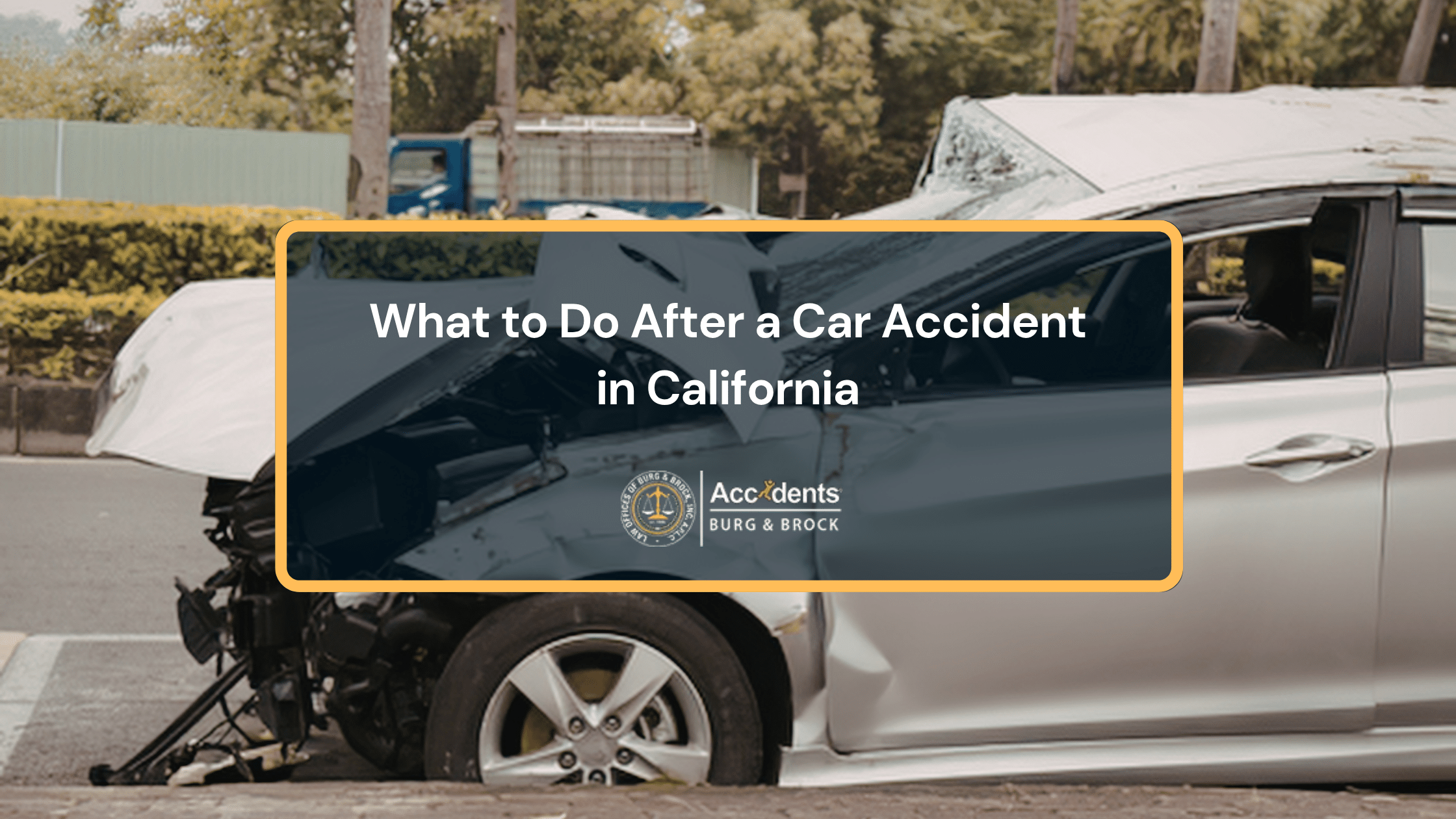
What to Do After a Car Accident in California
When a car accident happens, it can leave you shaken, confused, and unsure of what to do next. In those first few moments, the actions you take can significantly impact your safety, health, and future. Immediately after a car accident in California, there are certain necessary steps injury victims must take to protect themselves and preserve their rights to recovery. An experienced attorney can also assist in making sure you make the right decisions and avoid costly mistakes.
Burg & Brock has over 30+ years of experience in helping clients navigate the complex process of personal injury claims. We understand how overwhelming this time can be, and our team is here to guide you every step of the way. Reach out to book a free consultation today.
This article dives into the important steps to take immediately after a car accident, California's legal requirements, and the challenges most accident victims face when pursuing compensation.

According to the California Office of Traffic Safety, more than 216,000 people were injured or killed in motor vehicle crashes across California in 2022. A car accident in California can be devastating and life-threatening for most victims. Knowing the right steps to take is important to protect your rights and preserve your ability to seek compensation. Below are the practical steps to take after a car accident.
After a car accident, your first priority should always be immediate safety. Try to stay calm and assess your surroundings. If possible, carefully move your vehicle to the other side of the road or a nearby safe area away from traffic. This helps to reduce the risk of another collision. Also, turn on your hazard lights right away so that other drivers can clearly see your vehicle and slow down.
After this, check yourself for any visible injuries before checking on your passengers and any other third parties involved. Look for visible signs such as bleeding, swelling, or difficulty breathing or moving. Even if the injuries do not look serious, ask each person how they feel, because some injuries may not be immediately apparent. If someone is seriously injured, avoid moving them unless there is an immediate danger, such as fire or heavy traffic. Keeping injured individuals still and calm can prevent further harm.
After ensuring that everyone is safe, the next step is to contact emergency services. If anyone is injured, no matter how minor it may seem, call 911 right away. When speaking to the emergency operator, clearly explain your location, including street names, nearby landmarks, or intersections, so help can find you quickly. Also, inform them about the number of people involved and describe any injuries you can see.
Even in situations where injuries appear minor, it is still wise to seek immediate medical attention, as some conditions, such as internal injuries or whiplash, may not show symptoms immediately. Stay on the call until the operator tells you to hang up, and follow any instructions they provide. Emergency responders, including paramedics and police officers, are trained to handle accident situations and will ensure that everyone receives the proper care and medical assistance needed at the scene.
California law requires that accidents involving injuries or significant property damage be reported to law enforcement. This could be the local police or the California Highway Patrol, depending on where the accident took place. Contacting the police helps to ensure that there is an official record of the accident.
When the police arrive, they'll assess the situation, document the scene, and create a police report, which is usually important during a claims process. During their investigations, they might question you about what happened. Try as much as possible to provide accurate details, but do not admit fault. This official report will help support any future legal claim.
If it is safe to do so, start collecting important information from the accident scene. Try exchanging details with the other driver involved in the accident. This should include full names, phone numbers, addresses, driver's license numbers, insurance company names, policy numbers, and vehicle information such as make, model, and license plate number.
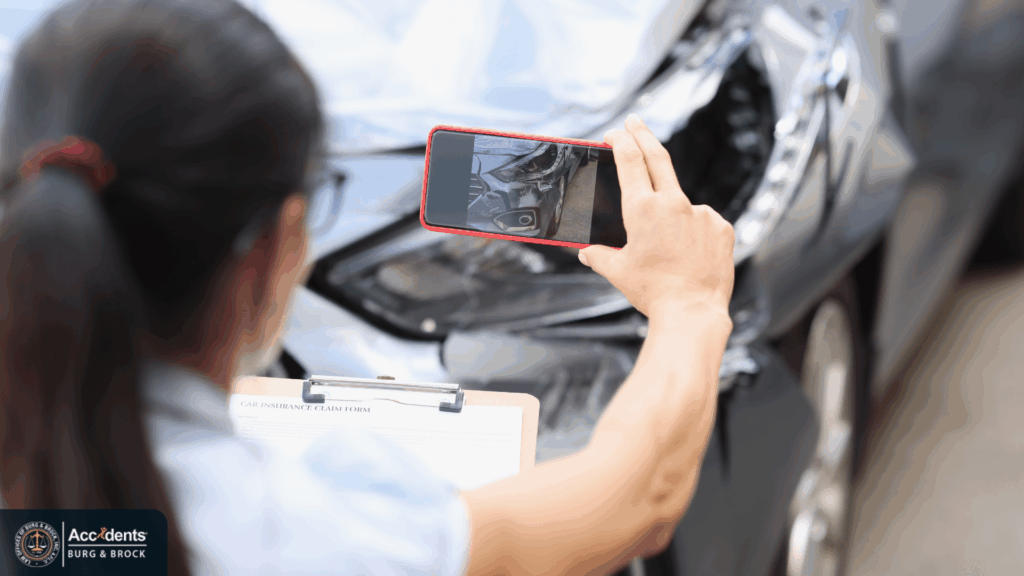
Aside from exchanging information, take time to document the scene thoroughly. Use your phone to take clear photos of the vehicles involved, focus on the damage, and try to get a clear shot from different angles. Also, capture images of the surrounding area, including road conditions, traffic signs, signals, and any skid marks or debris. If there are witnesses nearby, politely ask for their contact information, as their statements may be helpful later.
After leaving the scene, the next thing to do is to contact your own insurance company and notify them of the auto accident. Provide them with accurate details of what took place and the people involved. This helps to initiate your insurance claim. Be careful when speaking with insurance adjusters, especially from the other driver's insurance company.
Avoid giving a recorded statement without understanding your legal rights, as it could affect your claim. Your insurer will review your insurance policy, assess vehicle damage, and determine what is covered, including medical payments and repairs related to the California car accident.
It is always important to speak with a car accident lawyer immediately after an accident. They can help explain your legal rights and options to you. Many personal injury attorneys offer free consultations and can guide you through the legal process of a claim.
They can assist you in gathering evidence, negotiating with insurance companies, and offering strong legal representation. A lawyer can help you pursue compensation for medical expenses, lost wages, and other damages. With proper legal counsel, you are more likely to achieve a fair settlement.
After a car accident in California, it is very important to understand what your insurance policy will actually cover. A lot of people have insurance but do not fully understand how it works until they need to file an insurance claim. Taking the time to review your insurance coverage will help you know what costs your insurance company will pay and what you will have to pay yourself. There are basically three common types of coverage you should look out for in your policy.
The first is the collision coverage. This helps to pay for vehicle damage after a car crash, no matter who caused the accident. For example, if your car is damaged after an accident, collision coverage covers repairs and replacement. On average, collision coverage can pay up to the actual value of your car, which can range from about $3,000 to $30,000 or more, depending on your vehicle. However, you'll have to pay a deductible, which is usually between $500 to $1,500, before your insurer pays the rest.
The second is liability coverage. This is very important under California law because it covers damages or injuries you cause to other people. If you are at fault in an auto accident, your liability coverage can help you pay for the other party's medical expenses, property damage, and even their medical bills. In California, the minimum required limits are around $15,000 for injury to one person, $30,000 for injury to multiple people, and $5,000 for property damage. However, many drivers choose higher policy limits such as $25,000, $50,000, $100,000 or even more to better protect themselves.
The third is comprehensive coverage, which, as its name suggests, is all-encompassing. It does not apply only to collisions; instead, it covers damages caused by things such as fire, theft, vandalism, or natural events. Although it does not apply in a typical car accident, it is still an important part of a complete insurance policy. Similar to collision coverage, comprehensive coverage often pays up to the value of your car. However, its deductibles are usually lower and can range from $250 to $1,000
Aside from these three, you can include medical payments coverage to your insurance policy, which ranges from $1,000 to $10,000 and helps cover immediate treatment regardless of who is at fault. In more serious car accident cases involving severe injuries, you can choose to file a personal injury claim to recover more than what insurance covers. This can include not only current medical bills, but also future medical costs, lost income, and other damages.
California follows a pure comparative fault rule for motor vehicle accidents. This means more than one person can share responsibility for the same crash. Even if you are partly at fault, you may still recover compensation. Your recovery is reduced by your percentage of fault. For example, in 1979 Glen Gregos, a teenage motorcycle rider, was seriously injured during a race organized by the American Motorcycle Association and the Viking Motorcycle Club.
Gregos claimed the race was negligently planned and supervised. The defendants argued that Gregos and his parents also shared responsibility for the accident. The Supreme Court of California ruled that liability could be divided among all parties according to each person's share of fault.
Fault is determined by reviewing all available evidence from the accident. Insurance companies, attorneys, and courts examine police reports, witness statements, photographs, video footage, and vehicle damage. Traffic laws and the actions of each driver are also considered. The goal is to determine how much each party contributed to the collision.
A police report can play an important role after an accident. It often includes the officer's observations, statements from those involved, and details about the crash scene. While the report does not decide fault by itself, it can support your claim. Strong evidence, including medical records and witness testimony, can also help establish liability.
There are certain rules you must follow after a car accident in California. For instance, California law requires you to report certain accidents to the California Department of Motor Vehicles. You must report the accident if anyone was injured no matter how minor, there was a death, or the property damaged is more than $1,000. You are expected to do this within 10 days of the accident in California. To report the accident, you will need to fill out a form called SR - 1. This form requests certain details such as:
When filling out the form, ensure that all details are correct. Note that this report is separate from the police report, so you may still need to do both. It is important to report the accident on time to preserve your ability to file an insurance claim or car accident claim later. Additionally, California has a statute of limitations that requires crash victims to take legal action within two years of the incident.
Not every accident case requires a lawyer; however, it is always advisable to get legal help. Speaking with a personal injury attorney is especially important in cases involving serious injuries, disputes about liability, insurance companies' unwillingness to offer fair settlements, and high medical costs. A car accident lawyer has a deep understanding of personal injury law and can guide you through the legal process.
Car accidents can cause injuries that range from mild to life changing. Some injuries are easy to notice right away, while others may take hours or even days to appear. Common injuries include whiplash, broken bones, spinal injuries, concussions, and cuts or bruises. Even a low-speed crash can cause injuries that require medical attention.
Some symptoms do not appear immediately after a collision. Neck pain, headaches, dizziness, numbness, and back pain may develop later as the body responds to the trauma. Waiting too long to seek medical care can allow an injury to worsen. A prompt medical evaluation helps doctors identify hidden injuries before they become more serious.
Getting medical treatment as soon as possible also protects your legal claim. Medical records create a clear connection between the accident and your injuries. They document the diagnosis, treatment plan, and recovery process. Insurance companies often rely on these records when evaluating the value of a car accident injury claim.
| Common Injury | Possible Symptoms | When to Seek Medical Attention | Why It Matters for Your Claim |
| Whiplash | Neck pain, stiffness, headaches, limited movement | As soon as symptoms begin, even if they seem mild | Medical records help show the injury resulted from the crash. |
| Concussion | Headache, dizziness, confusion, nausea, memory problems | Immediately after any head impact or loss of consciousness | Early diagnosis links the brain injury to the accident. |
| Spinal Injury | Back pain, numbness, weakness, difficulty walking | Seek emergency care if symptoms are severe or persistent | Imaging and treatment records support compensation for long-term injuries. |
| Broken Bones | Swelling, severe pain, bruising, loss of movement | Visit an emergency room or urgent care immediately | X-rays and treatment records provide strong evidence of injury. |
| Soft Tissue Injury | Muscle pain, swelling, tenderness, reduced mobility | Schedule a medical evaluation within 24 hours | Medical documentation helps prevent insurers from disputing the injury. |
| Internal Bleeding or injuries | Abdominal pain, chest pain, difficulty breathing, fainting | Call emergency services without delay | Immediate treatment can be lifesaving and creates important medical evidence. |
| Cuts and Lacerations | Bleeding, deep wounds, risk of infection | Seek treatment if the wound is deep or continues bleeding | Medical records document the severity of the injury and any permanent scarring. |
One frequent challenge is dealing with insurance companies and their representatives. They are responsible for investigating your claim and deciding how much money they are willing to pay. The goal of these insurance adjusters is to settle the case as quickly as possible and for a very small amount. Hence, after an accident, you may receive a fast settlement offer. While this may seem helpful at first, it is important to be very careful.
Quick and early offers are usually less than your losses and may not be able to make up for medical expenses, property damage, and other damages. Many people make the mistake of accepting these offers too quickly because they are stressed or need money for immediate treatment or repairs. However, once you accept a car accident settlement, you cannot go back and ask for more, even if your medical bills or repair costs increase.
For this reason, it is essential for you to first understand your rights before making any decision. Take time to review the offer or speak with a car accident lawyer to assist you in avoiding making costly mistakes. Another challenge accident victims may face is gathering evidence. Most people wait too long before deciding to take legal action, and this can significantly affect their ability to collect full evidence. Strong documentation is usually the bedrock of any claim.
Without strong proof, it will be difficult to defend your claim and obtain a favourable outcome. Because of this, it is important to gather crucial evidence immediately after the crash to avoid losing it. There are also situations where the case becomes even more difficult because the other driver does not have enough insurance coverage or does not have insurance at all. When this happens, you may need to rely on your own insurance policy if it includes options like uninsured motorist coverage to help cover your losses. Our guide to uninsured and underinsured motorist coverage in California (PDF) explains when that coverage applies and how to file a claim with your own insurer.

One important way to protect your rights is to keep clear and complete records. This is called documentation and can help you a lot when dealing with an insurance claim. Many people tend to forget the details of the accident over time, but writing things down early helps you remember exactly what happened in detail. It is important to keep a personal record of the accident. Write out the date, time, and place of the accident.
Describe how the accident happened, the parties involved, and the injuries sustained. Also, keep all communication related to the accident. This includes messages, letters, emails, and phone calls with insurance companies. As Isaac Radnia, a personal injury lawyer at Burg & Brock puts it, "Insurance companies begin evaluating a claim almost immediately after a crash. The stronger your evidence and documentation, the better your chances of recovering fair compensation."
As previously mentioned, engaging a lawyer can also go a long way in protecting your rights. They can help you deal with insurance companies, review settlement offers, and make sure you obtain fair compensation. Another major way to protect your rights is by taking legal action early. Waiting too long to file a claim or pursue legal action can limit your ability to recover maximum compensation. Filing on time can make the process easier, especially when gathering evidence.
Have you or your loved one been a victim of a car accident in California? You are not alone, and you do not have to go through everything by yourself. Immediately after an accident, most people can feel overwhelmed and confused.
However, taking the right step can help protect your rights and improve your chances of a fair settlement. Reaching out for legal guidance can also give you more confidence as you navigate the claims process. A good lawyer can help you avoid mistakes, reduce stress, and give you peace of mind.
At Burg & Brock, you can rest with confidence knowing that your case is in good hands. With our team of experienced personal injury lawyers working diligently to ensure you secure fair compensation, you can focus on your recovery while we handle the difficult parts for you. To get started, you can call 818-351-7472
Below are common questions on what to do after a car accident in California and their respective answers.
You should report the accident to your insurance company as soon as possible. In addition, if the accident caused injury, death, or damage over $1,000, you must report it to the California's Department of Motor Vehicles (DMV) within 10 days. Reporting on time helps avoid problems with your claim and keeps you in line with the law.
Yes, it is usually a good idea to contact the police, especially if there are injuries or major damage. The police will create an official accident report, which can help support your case when dealing with insurance or any disputes later.
First, make sure everyone is safe and check for injuries. Call for prompt medical care if needed. Move to a safe place if possible and turn on your hazard lights. Exchange information with the at-fault driver and take photos of the scene. Report the accident to the police and your insurance company. After that, seek medical care and keep records of everything.
California follows a rule where fault can be shared between drivers. This means even if you are partly at fault, you may still receive compensation. However, the amount you receive may be reduced based on your level of responsibility.
Yes, you may still be able to file a claim against the other driver if they were at fault. However, not having insurance can limit what you can recover and may also lead to penalties. It is always better to have proper coverage to protect yourself.
Disclaimer: This content is for general informational purposes only and should not be taken as legal advice. Every situation is different, and the information provided here may not apply to your specific case.
Reading this content does not create a lawyer-client relationship. If you need advice about your situation, it is best to speak directly with a qualified legal professional who can guide you based on your individual circumstances.

Cameron Brock is a recognized personal injury lawyer in Los Angeles with extensive experience and success representing individuals and families in catastrophic personal injury and wrongful death cases.
Cameron’s established track record of helping those who have been harmed by wrongful conduct, violations of safety rules, and defective products has focused on claims involving automotive product defect, tire product defect, commercial truck accidents, trash truck accidents, airplane and helicopter crashes, train disaster, government liability for dangerous condition of public property, and general negligence.
Read more about Cameron BrockWe turn your pain into payouts. No stress, no upfront fees, just real results when you need them most.
Choose which categories of cookies and tracking technologies you allow on burgbrock.com. Strictly necessary cookies are always on so the site can function.
Required for the site to load, keep you signed in, and remember your preference choice. Always active.
Lets us see which pages people visit so we can improve the site. No personal data is sold.
Allows ad partners to measure the performance of ads you may have seen and show more relevant ads.
Powers extras like chat, embedded video, and remembered form fields. Turning these off may break some features.