How Is Fault Determined in a California Car Accident
Fault in a California car accident is determined by analyzing traffic laws, evidence, and negligence principles to decide which driver acted carelessly and caused the crash. Various bodies evaluate police reports, witness statements, physical evidence, and whether a driver violated the California Vehicle Code to prove fault. It is also used to assign a fault percentage under California's pure comparative negligence rule. This process directly impacts your car accident claim, including who pays for medical bills, property damage, lost wages, and other losses.
For more than 30 years, Burg & Brock has assisted injured victims in protecting their interests while fighting for their rights. With over $1 billion in recovery, we have what it takes to ensure that whoever is responsible for your accident is held accountable. Contact us now to seek justice and recover the compensation you truly deserve.
This article explains how fault is determined in a car accident in California and how a lawyer can help protect your rights and maximize compensation.

California follows an at-fault system for car accidents. This means the person who caused the accident is usually responsible for paying for the damages. These damages can include medical bills, lost income, vehicle repairs, and other accident-related losses.
This is different from a no-fault state, where drivers typically turn to their own insurance company for personal injury protection regardless of who caused the crash. In California, the injured person usually seeks compensation from the driver who was responsible for the accident..
Because California is an at-fault state, proving fault is an important part of any car accident claim. The injured person must show that the other driver acted carelessly and that their actions caused the accident and resulting damages. Crucial evidence such as police reports, witness statements, photographs, video footage, and medical records can help establish fault.
Several factors are used when evaluating fault in California car accident cases, especially when multiple vehicles or complex scenarios like intersection accidents or parking lot accidents are involved. First, traffic law violations play a major role. If a driver ran a red light, ignored a stop sign, made an unsafe turn, or engaged in reckless driving, it creates a strong presumption that the driver acted negligently.
For example, the driver making a left turn must yield to oncoming traffic and is often considered the at-fault driver unless other facts show otherwise. Second, physical evidence is critical. Skid marks, vehicle damage patterns, and photos of the scene are examined to reconstruct how the accident occurred. This helps experts determine speed, braking behavior, and the point of impact in a car crash.
Third, witness statements and digital documentation matter. Witnesses often provide neutral accounts of how the accident occurred, and dashcam footage or surveillance video is increasingly vital in modern car accident cases. Finally, medical records and injury evidence help connect the crash to bodily injury or severe injuries, supporting claims made by injured victims.
Fault determination in California is based on negligence laws in California. To establish negligence, four elements must be proven: a legal obligation/ duty, breach of that duty, causation, and damages. California follows a pure comparative negligence rule, meaning drivers share fault when applicable. Even if you are partially responsible, you can still recover compensation, but your recovery is reduced by your fault percentage.
According to the National Highway Traffic Safety Administration (NHTSA), driver-related factors are involved in approximately 94% of crashes, with specific causes including recognition errors (41%), decision errors (33%), and performance errors (11%), highlighting how driver behavior plays a central role in fault determination. The table below illustrates how comparative negligence works.
| Total Damages | Your Fault Percentage | Compensation You Receive |
|---|---|---|
| $100,000 | 0% | $100,000 |
| $100,000 | 20% | $80,000 |
| $100,000 | 30% | $70,000 |
| $100,000 | 50% | $50,000 |
Evidence is the foundation of any car accident fault determination. Police reports are a crucial piece of evidence in determining fault after a car accident, as they include observations from law enforcement officers, statements from drivers and witnesses, and any citations issued. These reports often include an accident report, diagrams, and initial conclusions about how the accident occurred.
Physical evidence, such as skid marks, vehicle damage, and accident scene photos, plays a significant role in reconstructing the crash and establishing fault. Investigators analyze these details to determine speed, direction, and impact. Witness statements can provide valuable insight into how the accident occurred and are often considered more reliable than the involved drivers' accounts.
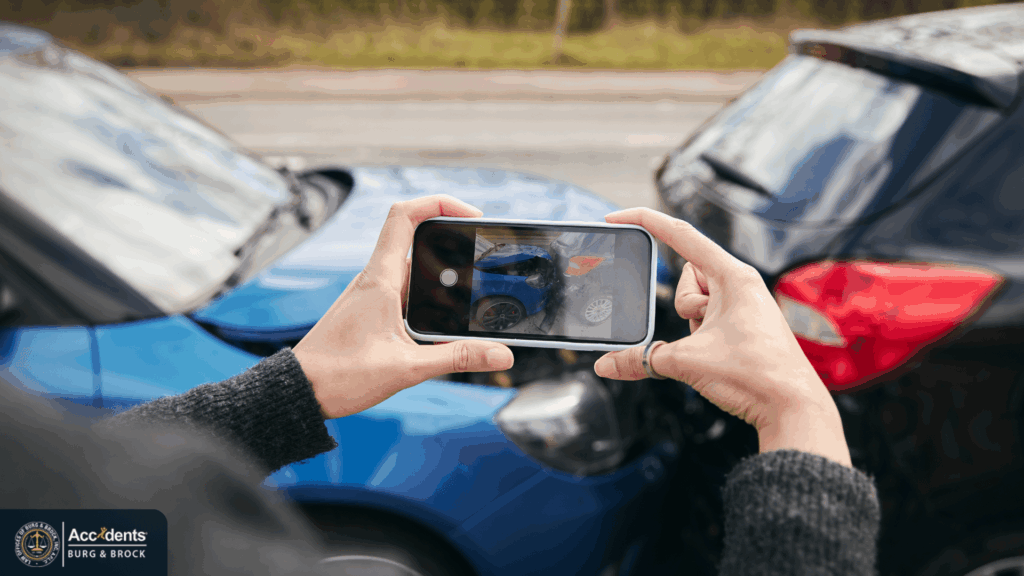
To strengthen your claim, gather as much evidence as you can. Take clear photos from multiple angles, keep copies of all medical records, and avoid discussing fault with the other driver at the scene. We also recommend keeping a simple timeline of events, as this can be extremely helpful during an insurance investigation
In addition, digital documentation, such as dashcam footage and surveillance video, has become increasingly important in accident cases. This is because they often provide clear, objective evidence of what occurred. After a crash, seeking medical attention right away helps create a record of your injuries and related expenses, while taking photos of vehicle damage and road conditions preserves critical visual evidence.
It's also important to gather contact information from any witnesses and notify the police so an official accident report can be filed. As soon as possible, write down your own recollection of the incident to capture details that might otherwise fade over time. Taken together, these steps can strengthen your ability to prove fault and help you avoid costly mistakes.
As previously mentioned, California uses a legal rule called comparative fault, sometimes called comparative negligence. This rule applies when more than one person shares responsibility for a car accident. Instead of preventing an injured person from recovering compensation, California allows them to recover damages even if they were partly at fault for the crash.
Under this system, the amount of compensation a person receives is reduced by their percentage of fault. For example, if a driver suffers $100,000 in damages but is found 20% responsible for the accident, they can still recover $80,000. If they are found 40% responsible, they can recover $60,000.
Comparative fault often plays a major role in settlement negotiations. Insurance companies may argue that an injured person was partly responsible for the accident in an effort to reduce the amount they have to pay. Because of this, evidence such as accident reports, witness statements, photographs, video footage, and expert opinions can be important when determining fault.
If a case goes to court, a judge or jury may decide how much fault each party shares. The final compensation award will then be adjusted based on those fault percentages. Understanding comparative fault is important because even a small change in fault allocation can significantly affect the amount of compensation a person receives after a car accident.
For instance, consider a scenario where a driver makes a left turn at an intersection and collides with an oncoming vehicle. Initially, it may appear that the turning driver is automatically at fault. However, during the investigation, dashcam footage reveals that the oncoming driver speeding well above the limit and ran a yellow light just as it turned red, showing how the crash happened in a different sequence than first thought.
In this situation, fault is not assigned entirely to one party. Instead, under California's comparative negligence rule, both drivers involved may share responsibility under the same circumstances seen across countless cases. The turning driver may be found 60% at fault for failing to yield, while the other driver is 40% at fault for speeding and unsafe driving. This directly impacts how compensation is calculated and distributed.
InImmediately after a car accident, there are certain crucial steps to take to protect your right and strengthen any future insurance claim or legal case. Below are some of them:
Pull over safely, check yourself and any passengers, and call 911 if anyone is hurt. Leaving the scene of a California car accident can lead to criminal charges under Vehicle Code Section 20002.
Do not say "I'm sorry" or speculate about what happened. Anything you say at the scene can be used by the other driver's insurance to push fault onto you. Stick to facts when talking with officers.
Photograph vehicle damage, the position of the cars, skid marks, traffic signals, visible injuries and other evidence from the crash scene. Get the other driver's name, license, insurance information, and plate number. Collect witness contact details before anyone leaves.
Wait for the responding police officer and request the report number. The police report is one of the most important pieces of evidence in any subsequent liability dispute.
Notify your own insurance company immediately, possibly within 24 to 72 hours and stick to the facts. Avoid giving a recorded statement to the other party's insurer without legal advice first.
In California, the steps used to determine liability and determine financial responsibility after an at fault accident are crucial for deciding who pays for damages, medical bills, and other losses. In our experience, the driver who is found to be at fault for the crash is usually responsible for paying these costs through their insurance. But fault isn't always clear, especially in accidents where there is conflicting evidence, more than one car, or shared responsibility.
Insurance companies, lawyers, and sometimes courts follow a set process in order to get a fair result. Knowing how this process works can help you protect your rights, avoid making mistakes that will cost you money, and make your claim stronger from the start.
Some cases are simple, but others can get complicated quickly, especially if there is disagreement about who is to blame. That is why knowing how the process works can have a big effect on the outcome of your claim. If you are unsure about anything at any point, working with a knowledgeable car accident attorney can help make sure that the blame is placed correctly and that you get the money you deserve.
Insurance companies play a major role in determining fault, especially because California follows an at-fault system rather than a no-fault model. After an accident, insurance adjusters conduct detailed investigations, reviewing police reports, photographs, witness statements, and other available evidence to understand what happened. As part of this process, a claims adjuster evaluates liability coverage, analyzes vehicle damage patterns, and may even rely on accident reconstruction to form a clearer picture of the events.
In addition, adjusters consider whether either driver violated traffic laws or has a poor driving record, completing a thorough liability assessment and identify which party's insurance policy, typically that of the at-fault driver, should cover the damages. As of January 1, 2025, California will require minimum liability insurance of $30,000 per person and $60,000 per accident for bodily injury. These factors affect how claims are evaluated and paid.
When disagreements arise over fault, the resolution process may involve settlement negotiations, mediation, arbitration, or, in more complex cases, litigation. These disputes are especially common when both drivers deny responsibility or when fault is shared and difficult to determine, such as in multi-vehicle accidents involving more than two vehicles or multiple drivers, sometimes making binding arbitration or a California auto accident lawsuit necessary to reach a final decision.
It is important to understand that insurance companies and courts may view fault differently. Insurance adjusters aim to resolve claims quickly and minimize payouts, while courts focus on a more detailed legal analysis of evidence and testimony. As a result, an insurance company may assign fault in a way that benefits its financial interests, whereas a court may reach a different conclusion after a full review of the facts. The financial implications for an injured driver can be significant, since the difference between an insurer’s view and a court’s view often dictates whether a fair settlement is reached. This is why disputed claims sometimes proceed to litigation.
A police report plays a crucial role in determining fault in a car accident in California because it provides an official, third-party account of the incident. This often includes a preliminary assessment of what happened and who may be responsible. Since California is an at-fault state, not a no-fault state, the report becomes especially important in helping insurance companies assign fault and determine whether the at-fault driver's insurance should cover damages such as medical expenses and vehicle repairs.
The report typically contains key details such as the officer's observations from the scene, statements from you, the other driver, and witnesses, as well as any traffic citations issued if a driver failed to follow California law. It may also include accident diagrams and notes that help clarify how the collision occurred. However, it is important not to admit fault at the scene, as statements can be included in the report and later used in fault disputes.
Furthermore, while a police report is not always the final determination of fault in a car accident, it carries significant evidentiary weight in both insurance claims and legal proceedings. Insurance companies rely heavily on it when evaluating liability, which can ultimately impact insurance premiums and coverage decisions, including whether uninsured motorist coverage applies.
Additionally, when supported by strong evidence such as medical records and photographs, the report can significantly influence how fault is assigned and help prevent costly mistakes. In more complex cases, especially when disputes arise, speaking with a legal professional for a free consultation can provide clarity on your rights and next steps.
Determining fault in a car accident in California is not always straightforward, as various challenges can complicate the process and hinder reaching a clear conclusion. From conflicting evidence to legal complexities, these issues can delay claims, create fault disputes, and impact how liability is ultimately assigned.
One of the most common challenges is conflicting evidence, particularly when witness accounts or driver statements do not align. For instance, you and the other driver may provide completely different versions of how the accident occurred, especially in situations like intersection collisions where visibility and timing are disputed.
Without clear corroboration, insurance companies may struggle to assign fault accurately, often relying on additional evidence such as photos, vehicle damage patterns, or accident reconstruction to fill in the gaps. In addition, legal complexities can further complicate fault determination, particularly when multiple parties are involved. California follows a comparative negligence system, meaning that parties involved can share responsibility for the accident.
As a result, courts and insurance companies may need to divide liability and assign each party a percentage of fault, which can directly affect compensation, medical expenses, and even insurance premiums. These layered issues make fault matters more difficult to resolve and often require careful analysis to avoid costly mistakes.
However, not all fault disputes are complex. In straightforward cases, such as rear-end collisions where one driver clearly failed to stop, fault may be determined quickly with minimal disagreement. The complexity often depends on the amount and clarity of available evidence.

A car accident lawyer can play a critical role in determining fault in a car accident in California by using legal expertise to gather evidence, build a strong case, and guide clients through the process. They understand how to establish negligence, work with expert witnesses when needed, and present evidence in a way that clearly shows how the other driver or multiple parties may be responsible.
In addition, they ensure compliance with California law and help clients avoid making costly mistakes, such as choosing to admit fault too early or failing to properly document injuries and medical expenses. Beyond building the case, a lawyer also provides strong advocacy during fault disputes, whether in negotiations or court proceedings.
They handle communication with insurance companies, challenge unfair attempts to assign fault, and work to ensure that the at-fault driver's insurance is held accountable. Furthermore, if the other driver is uninsured or underinsured, a lawyer can help pursue financial compensation through uninsured motorist coverage, making sure clients receive the financial recovery they are entitled to. Additionally, most personal injury firms work on contingency, so legal fees are only paid out of any settlement or award the client receives.
As Cameron Y. Brock often notes, “The strongest cases are built on clear evidence and early documentation. What you do immediately after an accident can significantly impact how fault is assigned.”
Navigating the complexities of fault determination in California car accidents can be challenging. Unlike many general guides, this article breaks down the actual process used to determine fault, including real-world scenarios, legal process, and practical steps you can take to strengthen your claim. Knowing these elements can empower you to protect your rights and ensure fair compensation.
Burg & Brock is a personal injury law firm renowned for their dedication to guiding clients through the complex process of a claim. Our team of experienced lawyers can assist with gathering evidence, investigating witnesses, and representing you in court. Reach out to us today to get started.
Below are frequent questions about how fault is determined in a California car accident and their provided answers.
Evidence includes police reports, witness statements, medical records, and physical evidence like skid marks and vehicle damage patterns used to prove fault in car accident cases. Digital documentation, such as dashcam footage and surveillance video, also helps reconstruct how the accident occurred and supports a car accident claim.
Yes, under the pure comparative negligence rule, drivers share blame, and compensation is reduced based on your fault percentage. Even if you are partially responsible, you can still recover compensation for medical expenses, property damage, and lost wages.
Yes, police reports are a crucial piece of evidence because they include observations from law enforcement officers, citations, and an official accident report. They carry strong evidentiary value and heavily influence insurance companies when assigning car accident fault.
Insurance companies use liability insurance policies to determine which party pays, usually the at-fault driver's insurance in this at-fault state. Coverage like uninsured motorist coverage may apply if the other driver lacks insurance, affecting how accident victims recover compensation.
Common mistakes include failing to seek medical attention, not documenting the scene, or admitting fault too early before all evidence is reviewed. These errors can weaken your ability to prove fault, increase insurance premiums, and reduce your ability to recover compensation.
Legal Disclaimer: The information provided in this article is for general informational and educational purposes only and should not be construed as legal advice. Laws regarding personal injury and statutes of limitations may vary depending on the specific facts of each case and may change over time. Reading this content does not create an attorney-client relationship between you and Burg & Brock or any of its attorneys.
If you have been injured or believe you may have a legal claim, you should consult a qualified attorney to obtain advice regarding your specific situation. Do not rely solely on the information presented here when making legal decisions. Prior results do not guarantee a similar outcome, and every case must be evaluated on its own merits.

Cameron Brock is a recognized personal injury lawyer in Los Angeles with extensive experience and success representing individuals and families in catastrophic personal injury and wrongful death cases.
Cameron’s established track record of helping those who have been harmed by wrongful conduct, violations of safety rules, and defective products has focused on claims involving automotive product defect, tire product defect, commercial truck accidents, trash truck accidents, airplane and helicopter crashes, train disaster, government liability for dangerous condition of public property, and general negligence.
Read more about Cameron BrockWe turn your pain into payouts. No stress, no upfront fees, just real results when you need them most.
Choose which categories of cookies and tracking technologies you allow on burgbrock.com. Strictly necessary cookies are always on so the site can function.
Required for the site to load, keep you signed in, and remember your preference choice. Always active.
Lets us see which pages people visit so we can improve the site. No personal data is sold.
Allows ad partners to measure the performance of ads you may have seen and show more relevant ads.
Powers extras like chat, embedded video, and remembered form fields. Turning these off may break some features.