
Recovering from surgery after a fall is hard enough without an insurance adjuster calling you twice a week. Average slip and fall settlements with surgery in California typically run from the high five figures into the hundreds of thousands. Where your own case lands depends on injury severity, total medical costs, lost wages, and the strength of the liability evidence. Surgery raises the floor because an operative report gives you objective proof that an insurance company cannot easily dispute.
Burg & Brock has represented injured Californians since 1996, handling car accidents, catastrophic injuries, slip and fall accidents, and wrongful death claims. We carry an A+ Better Business Bureau rating with no complaints on file, and we take every case on contingency. Call Burg & Brock for a free consultation, and we will tell you what your claim is worth.
Below you will find how these settlements are valued, what moves the number, the legal process in California, and answers to common questions.

A slip and fall settlement is money paid by a property owner or their insurer to close your claim without a trial. Most slip and fall cases settle. Trials are expensive and unpredictable, so both sides usually prefer a negotiated number.
Settlements matter in personal injury cases because they end the uncertainty. Once you sign a release, your claim is over for good. That is why the timing of a settlement matters as much as the amount. Settling before you know the full cost of your medical treatment can leave you paying for future surgeries yourself.
Slip and fall cases range from minor injuries that heal in weeks to severe injuries needing several operations. Moderate injuries sit in between, and serious injuries with permanent restrictions sit near the top. A slip and fall injury requiring surgery is valued very differently from one that does not.
Your claim rests on California premises liability law. A property owner must keep the premises reasonably safe and warn you about hazards they know about. You have to show the owner knew or should have known about the danger. California law addressed this in Ortega v. Kmart Corp. (2001) 26 Cal.4th 1200. The California Supreme Court held that you can prove notice another way. You show the area went uninspected for an unreasonable stretch of time.
Surgery changes the value of a claim more than any other single fact. It converts a disputed soft tissue complaint into a documented, objective injury. An operative report is difficult for an insurance company to argue away.
Surgery also multiplies your economic damages. You add the surgeon, the anesthesiologist, the facility, the implants, and months of physical therapy. Recovery time grows, so lost wages grow with it. Many clients face a second procedure to remove hardware a year later.
There is a non-economic side too. Surgery means anesthesia, scarring, and a long stretch where you cannot lift your child or drive. Insurers assign more value to pain and suffering damages when the medical records show an operation.
“An operative report changes the conversation with an adjuster,” says Cameron Yadidi Brock of Burg & Brock. “Before surgery they argue about whether you were really hurt. After surgery they argue about the number. Those are very different negotiations, and the second one is where documented future medical costs do the work.”
There is no official database of California settlement amounts, because most settlements are confidential. What follows are general ranges seen in practice. They are illustrative and are not a prediction about your claim.
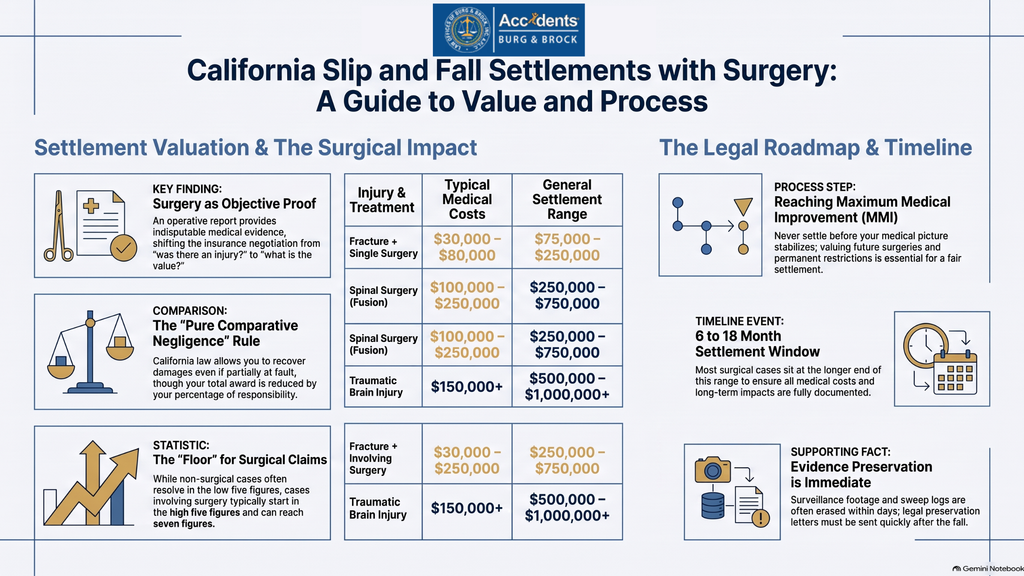
Cases involving surgery generally start well above cases without one. A fall accident with a clean recovery and no operation often resolves in the low five figures. Once surgery enters the picture, the floor rises sharply, and catastrophic injuries with permanent disability can reach seven figures.
The table below shows how injury severity tends to move settlement value in California slip and fall claims. Use it to understand the drivers, not to price your own case.
| Injury and treatment | Typical medical costs | General settlement range | What moves the number |
| Soft tissue, no surgery | $3,000 to $15,000 | $10,000 to $40,000 | Length of ongoing treatment, gaps in care |
| Fracture with single surgery | $30,000 to $80,000 | $75,000 to $250,000 | Hardware, weight-bearing limits, time off work |
| Spinal surgery such as fusion | $100,000 to $250,000 | $250,000 to $750,000 | Permanent restrictions, future surgeries |
| Traumatic brain injury with intervention | $150,000 or more | $500,000 to seven figures | Cognitive testing, lost earning capacity |
| Multiple surgeries, permanent disability | $250,000 or more | Seven figures | Life care plan, need for attendant care |
Location matters as well. A jury in Los Angeles County often values pain and suffering differently than a jury in a smaller inland county. Your attorney should price your claim against verdicts in the county where suit would be filed.

These are the key factors behind fall settlement amounts in California. Liability comes first. If the property owner cannot explain how a hazard sat there unnoticed, your leverage rises. Surveillance video, sweep logs, and prior complaints often decide this issue.
Your own conduct matters too. California follows a pure comparative negligence rule, so your recovery drops by your share of fault. If a jury finds you 30% responsible for looking at your phone, a $300,000 award becomes $210,000. You still recover something even if you are mostly at fault.
The defendant’s conduct cuts the other way. A store that ignored three prior reports of the same leak looks careless to a jury. Evidence of repeated warnings can lift settlement value well beyond the medical bills.
Insurance coverage sets a practical ceiling. A small business with a $500,000 policy and no assets limits what you can collect, no matter how serious your injuries. A national retailer changes that calculation entirely.
Falls on government property follow separate rules. You must file a government tort claim within six months of the date the fall occurred. Miss that deadline and your claim usually ends before it starts.
Economic damages are the losses you can add up on paper. They cover medical expenses already incurred, future medical expenses, lost wages, and reduced earning capacity. Keep every bill, pay stub, and mileage log.
Future medical costs are where surgical claims are won or lost. If your surgeon expects a revision procedure or long-term pain management, that projection belongs in the demand. Without it, you fund that care yourself after the release is signed.
Non-economic damages compensate for physical pain, emotional distress, and the loss of things you used to enjoy. There is no receipt for these. A journal describing your worst weeks does more than an adjective ever will.
This is the sequence we follow with clients after a serious fall. Start with immediate medical attention, ideally the same day. Immediate medical treatment protects your health and your claim at the same time. A same-day record ties the injury to the fall and removes the insurer’s favorite argument. Before you leave the property, report the fall and ask the manager for a written incident report. Take the names of anyone who saw it happen.
Next, preserve the evidence while it still exists. Photograph the hazard, the lighting, your shoes, and the surrounding area. Surveillance footage is often overwritten within days, so a preservation letter needs to go out quickly. From there, build the medical record. Attend every appointment and follow through on physical therapy, because gaps in treatment are the most common reason settlement value drops.
Wait until you reach maximum medical improvement before you negotiate. Only then can anyone value future surgeries and permanent restrictions accurately. Your personal injury lawyer then assembles the medical records, wage documentation, and expert opinions to pursue maximum compensation. Settlement negotiations usually open with a low offer. If the insurance company refuses to move, a slip and fall lawsuit often changes that.
Experienced personal injury attorneys earn their keep in the valuation and the negotiation. Most slip and fall attorneys work on contingency, so legal representation costs you nothing upfront. Knowing what fair compensation looks like keeps you from settling short. An experienced attorney will also tell you when to wait.
Most slip and fall cases settle in six to eighteen months. Surgical cases sit at the longer end, because you should not settle before your medical picture stabilizes. Waiting is usually the more profitable choice.
If you have to file suit, plan for longer. According to the Judicial Council of California, only 62% of general civil unlimited cases closed within 12 months. That covers fiscal year 2023 to 2024. Just 74% closed within 18 months and 82% within 24 months. Those figures fall short of the Judicial Council’s own targets of 75%, 85%, and 100%.
You also have a deadline. In California, you generally have two years from the date of injury to file a personal injury lawsuit. That makes early legal consultation essential. Immediate legal consultation protects both the deadline and the evidence.

Public agencies must disclose what they pay, which makes government settlements the most reliable public window into real California numbers.
In its fiscal year 2024 to 2025 claims report, the Los Angeles City Council approved 14 trip and fall settlements. They ranged from $70,000 to $462,500, and the median was $125,000. Almost every one involved an uplifted or cracked sidewalk. Two of them closed at $462,500 and $365,000.
That pattern is documented at scale. The Los Angeles City Controller found the City received more than 1,700 claims and 1,020 lawsuits for sidewalk injuries across five fiscal years. It paid out more than $35 million in settlements. Repeated notice of a known hazard is what turns a fall accident into a payout.
Those public records do not state whether a claimant had surgery, so one illustrative example completes the picture. A delivery driver falls on an unlit apartment stairwell with a loose handrail and fractures two vertebrae. He receives a single-level fusion, medical costs approach $210,000, and two prior tenant complaints about the light were in writing. Documented notice like that pushes a claim toward the upper end of the spinal range.
Falls are not rare events. The Centers for Disease Control and Prevention reports nearly 3 million emergency department visits each year among older adults alone. About 1.2 million hospital stays follow. Medical costs tied to those falls run roughly $80 billion annually.
Your case is worth what you can prove, not what a calculator estimates. Surgery raises the floor, but documentation of future medical costs and lost earning capacity decides the ceiling. California’s pure comparative negligence rule means even a partly at-fault claim is worth pursuing. The most expensive mistake is accepting an offer before you reach maximum medical improvement.
At Burg & Brock, we secure the sweep logs and footage before they disappear and work with treating surgeons on future care. Our slip and fall lawyer team has served injured Californians since 1996. Book a free case evaluation, and we will tell you what your claim realistically involves.
These are the questions we hear most often from clients recovering from surgery after a fall.
There is no single average, and any firm quoting one precisely is guessing. Settlement value turns on injury severity, total medical costs, lost wages, and how clearly the property owner was at fault. Surgical cases in California commonly resolve between roughly $75,000 and several hundred thousand dollars. Claims involving spinal fusion, traumatic brain injury, or permanent disability can exceed a million dollars. The strength of your liability evidence can matter as much as the severity of your injury.
Expect six to eighteen months for most surgical claims, and longer if you file suit. The main driver is your medical treatment, because you should reach maximum medical improvement before anyone values the claim. Settling early almost always costs you money. If litigation becomes necessary, California court data shows most civil unlimited cases take more than a year to resolve.
Injury severity and medical expenses set the foundation. On top of that sit lost wages, future medical expenses, and reduced earning capacity. Liability evidence then adjusts the number in either direction, and so does your share of fault under the pure comparative negligence rule. Available insurance coverage often sets the practical limit. Where your case would be tried also influences what non-economic damages are worth.
Compensation for physical injuries and related medical treatment is generally not taxable income under federal or California law. The picture changes for certain components. Interest paid on a settlement is usually taxable, punitive damages typically are, and reimbursement for medical expenses you already deducted may be as well. Lost wages within a physical injury settlement are generally excluded, though this trips people up. Ask a tax professional before you sign anything.
For a surgical claim, yes. These cases involve future medical costs, expert testimony, and defenses about notice and comparative fault. An experienced personal injury attorney knows how to prove the property owner should have found the hazard. Most work on a contingency fee basis and are paid only if they recover compensation for you. Given what a surgical claim is worth, going it alone against an insurer rarely pays.
Attorney Advertising: This article provides general information about California premises liability and personal injury claims. It is not legal advice, and no attorney-client relationship is created by reading it or by contacting our firm through this website. The settlement ranges and scenarios described are illustrative composites, not results obtained by Burg & Brock. Past results never guarantee future outcomes. Every claim depends on its own facts, the available insurance, the evidence of notice, and the applicable deadlines. Speak with a licensed California personal injury attorney about your specific situation.

Cameron Brock is a recognized personal injury lawyer in Los Angeles with extensive experience and success representing individuals and families in catastrophic personal injury and wrongful death cases.
Cameron’s established track record of helping those who have been harmed by wrongful conduct, violations of safety rules, and defective products has focused on claims involving automotive product defect, tire product defect, commercial truck accidents, trash truck accidents, airplane and helicopter crashes, train disaster, government liability for dangerous condition of public property, and general negligence.
Read more about Cameron BrockWe turn your pain into payouts. No stress, no upfront fees, just real results when you need them most.
Choose which categories of cookies and tracking technologies you allow on burgbrock.com. Strictly necessary cookies are always on so the site can function.
Required for the site to load, keep you signed in, and remember your preference choice. Always active.
Lets us see which pages people visit so we can improve the site. No personal data is sold.
Allows ad partners to measure the performance of ads you may have seen and show more relevant ads.
Powers extras like chat, embedded video, and remembered form fields. Turning these off may break some features.